ICT's and ICT's for Learning Design takes up alot of my study time. For it to be an effective aid and tool to support pedagogy, it needs to be tested and tried. I can see now that merging ICT's and pedagogy is no simple feat. Its going to be a major challenge for me. I can see now that the course employs many strategies as a way to include theories of connectivism and constructivism in the tasks. Adding to that, I can also see alot of using Blooms Domains and Engagement theory too. Sooo many ways and theories. So finding the balance is the key, as to not exclude a certain type of learner.
I feel I must apologise to Prensky for basically trashing his argument on the 'digital natives' debate. Why? cos my seven year old did exactly what Prensky argued. It was during a chess game my son was playing against some adults, that my child pulled out his DS and played between manouvers. This astounded me because initially I though my child was being rude, but when put in context to Prenskys argument, it became very clear that 21st century learners require fast outcomes, can mulit-task and still be engaged at two different things at the same time.
Now that said, how am I be going to teach these new learners when I feel antiquated myself? Doublts....many doubts.
My Family

Monday, 7 March 2011

Reflection on Profile Wiki
The profile wiki task was my introduction to the concept of the 'wiki'. As I have discovered that my learning preferences lies towards sensing, verbal and active styles, this task ticked many boxes for me. The wiki profile made sense, it was a logical progession of mini-tasks, and provided the end goal of getting to know my fellow classmates. I felt that I had achieved something and learnt a new skill.
Looking at this with the perpective of a 'newbie' I think that this type of task would support my learners in the future, firstly,as a great introduction to ICT's and secondly, as an 'ice breaker' within the class community. I would agree that this task supports the four learning theories we have been introduced to. Connectivism definitely, as it claims to be the learning theory for the digital age (Siemens). I have seen this in myself, where I will quickly read/watch something on the computer, make a qucik judgement of the material and definitely note how to get back there for clarification in the future. Thus choosing what I want to learn and creating the meaning that has significance for me. Constructivsm also is supported by this task, if we agree that 'social interaction has a large influence on learning'. (Vygotsky) The nature of the profile wiki forces students to have contact with their peers. Practices of behaviourism are present, as the wiki provides measurable outcomes, and example would be the tutorials for creating your wiki. To a lessor degree, cognitivism because the wiki highlighted each students way of learning.
How does this design support a diverse range of students? I suppose I am a good example of one end of the spectrum. A newbie to the world of wikis, I was able to complete the task. Those with greater experience would have little trouble with it. Also as a flex student, I could still participate whilst being quite a distance from the university campus. As an online activity, this supports learning that traditional methods could not. Distance would be a major stumbling block, and thus discount me to be eligible to participate. The activity itself is a good example of how ICT's could be used in the classroom, after all lets not forget that we are teachers training to teach 21st century learners.
Looking at this with the perpective of a 'newbie' I think that this type of task would support my learners in the future, firstly,as a great introduction to ICT's and secondly, as an 'ice breaker' within the class community. I would agree that this task supports the four learning theories we have been introduced to. Connectivism definitely, as it claims to be the learning theory for the digital age (Siemens). I have seen this in myself, where I will quickly read/watch something on the computer, make a qucik judgement of the material and definitely note how to get back there for clarification in the future. Thus choosing what I want to learn and creating the meaning that has significance for me. Constructivsm also is supported by this task, if we agree that 'social interaction has a large influence on learning'. (Vygotsky) The nature of the profile wiki forces students to have contact with their peers. Practices of behaviourism are present, as the wiki provides measurable outcomes, and example would be the tutorials for creating your wiki. To a lessor degree, cognitivism because the wiki highlighted each students way of learning.
How does this design support a diverse range of students? I suppose I am a good example of one end of the spectrum. A newbie to the world of wikis, I was able to complete the task. Those with greater experience would have little trouble with it. Also as a flex student, I could still participate whilst being quite a distance from the university campus. As an online activity, this supports learning that traditional methods could not. Distance would be a major stumbling block, and thus discount me to be eligible to participate. The activity itself is a good example of how ICT's could be used in the classroom, after all lets not forget that we are teachers training to teach 21st century learners.
Reflection on Phone Wiki
The mobile phones wiki was an interesting task. I liked De Bono's approach towards dissecting a topic. With the various coloured hats representing ideas and questions, I felt it allowed discussion to be multi-dimensional, adding flavour and shades of opinion, rather than neatly boxing a topic with a generalised statement. I suppose it is a reflection of life in general, nothing is black and white, and as educators in training, its important to teach with this in mind. How could this strategy support my learners? I think it covers most bases for supporting learning. In particular, the learning theories we spent some time on last week (behavourism, cognitivism, constructivism, and connectivism) are able to be implemented should I wish, as the phone wiki task does not exclude the possibility to use them. Constructivism and connectivism are the most obvious, as the wiki task supports their central ideas; personalised learning and creating/building connections repectively. Behaviourism and cognitism practices too, because the task allowed reinforced behaviours and the follow through of the cognitive process. The wiki is also a flexible platform for elearning, as all students participating have an equal opportunity to contribute, at a time of their choosing, regardless of location, and can also choose their level of invovement, thus allowing students to engage in the content, fostering greater awareness of their meta-learning. I certainly felt aware of this process as I completed the wiki and enjoyed that I could pinpoint these steps in my learning. Most beneficial to me was being able to read my peers comments, which highlighted some points for me that I had not considered. However I do feel that a downfall of the wiki (or student?) is that not all classmates have filled in the wiki and some students may miss a interesting point of view, due to lack of time to continuously refer back to the wiki.
Design Framework for eLearning
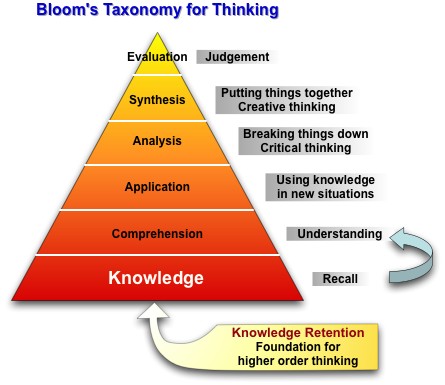
The task of designing an effective framework for excellent elearning is not simple. From the readings provided, it would seem that Bloom's Taxonomy is the accepted model for transitioning students from lower order thinking to higher order thinking. However as this is only a conceptual framework, it lacks the how or the platform to provide the setting for such learning to take place. Which is how Engagement Theory comes into play. This theory supposes that students must be meaningfully engaged in learning activites through interaction with others and worthwhile tasks (Greg Kearsley & Ben Shneiderman). So, it would be sound pedagogical practice to combine the two, providing opportunities for students to travel up Blooms ladder and engage in problem-solving based learning to acquire deep knowledge and real world skills.
A quick overview of the theories.
Bloom's Taxonomy of Learning Domains
Bloom maintains that there is 3 types of learning; cognitive, (knowledge), affective (attitude) and psychomotor (skills). Bloom's main argument is that in order for learners to move from basic learning or lower order thinking, the learner must progress through a series of steps to reach the ultimate goal of higher order thinking. Basically, in order for a learner to understand something they must be able to recall/remember it, in order for a learner to apply new knowledge they must have understand it, and so forth. (Blooms Taxonomy of Learning Domains). For the purposes of this task I will onlly use Bloom's cognitive domain.
 Engagement Theory
Engagement Theory is a framework for technological based learning and teaching. Its aim is to engage the learner, using three principles of 'relate, create, donate'. That is, learning through group work, where works are project based, and projects are to have an outside focus. Kearsley and Shneiderman argue that the success of engagement theory is due to collaborative nature of work, focussing on ambitious goals that assist those outside the classroom.
The Task- design an effective framework for eLearning
As the teacher is the greatest influence in the classroom, and that no two students are the same, it would be important for me to provide a balanced approach to creating an effective eLearning pedagogy. So somethings I would do/consider are;
A quick overview of the theories.
Bloom's Taxonomy of Learning Domains
Bloom maintains that there is 3 types of learning; cognitive, (knowledge), affective (attitude) and psychomotor (skills). Bloom's main argument is that in order for learners to move from basic learning or lower order thinking, the learner must progress through a series of steps to reach the ultimate goal of higher order thinking. Basically, in order for a learner to understand something they must be able to recall/remember it, in order for a learner to apply new knowledge they must have understand it, and so forth. (Blooms Taxonomy of Learning Domains). For the purposes of this task I will onlly use Bloom's cognitive domain.
Engagement Theory is a framework for technological based learning and teaching. Its aim is to engage the learner, using three principles of 'relate, create, donate'. That is, learning through group work, where works are project based, and projects are to have an outside focus. Kearsley and Shneiderman argue that the success of engagement theory is due to collaborative nature of work, focussing on ambitious goals that assist those outside the classroom.
The Task- design an effective framework for eLearning
As the teacher is the greatest influence in the classroom, and that no two students are the same, it would be important for me to provide a balanced approach to creating an effective eLearning pedagogy. So somethings I would do/consider are;
- An evaluation of the class standard of knowledg and skills, and further exploration of where individuals would sit within that realm. It would be poor practice to assume my class is homogenous in experience and skill.
- Consider the proportion of human contact to ICT contact and introduce varous mediums of digital devices.
- Design activities that allow for group and individual work, using ICTs to aid students form connections and build real world skills. Furthermore, incorporating ICT's as a learning tool and encourage students to take advantage of the many free applications.
- Create assessments that allow the students to dictate the basis for research and provide the space for students to explore those concepts that interest them, ensuring relevance to the students themselves.
- I believe that this framework gives me the space to include the learning styles and theories that we have been researching, and would incoporate these styles and theories in delivering this content, allowing students to 'climb' the cognitive ladder in their preferred learning style.
Saturday, 5 March 2011

PMI activity
PMI ACTIVITY
Greg Whitby: pedagogical dna for schooling http://www.youtube.com/watch?v=l72UFXqa8ZU&feature=related
And
21st Century Learning Matters
http://www.youtube.com/watch?v=2L2XwWq4_BY
Pluses (good points for your teaching context) all the benefits of the ideas presented in the readings.
· Innovative
· Reflective: looks at historical patterns, foundations, and power dynamics within current model
· Critical: able to recognise and name flaws in current model
· Child focussed: recognises the needs/behaviours/experiences of the students and identifies need for teachers to adapt rather than the child to adapt
· Recognises the value in shared, cooperative learning and co-constructive learning
· The digital world offer greater access to information ( and should the technology be provided to all schools for students to access) this then allows students greater exposure to information, including less mainstream ideas and alternative sources of information.
· Discusses the importance of teaching critical analysis skills to children, in that there is so much information students can access over the internet, the role of the teacher is not providing all the information, but rather the skill to critically evaluate the information and how reliable/ authentic/correct it may be.
· Engaging educators in a new discourse of teaching in the 21st Centaury
· Recognising the need for a new skill set for the digital age
Minuses (areas of the learning theory that will make your teaching difficult or ineffective) all of the dangers/problems associated with the ideas in the reading
· May encounter entrenched ways of thinking from other colleagues who do not share the same belief in the need to redesign teacher/learning in today’s context.
· May encounter parents who are challenged/unsupportive of new models of teaching/learning
· Parents may struggle to support students if they feel out of touch with teaching models
· No clear/ accepted model for 21st century learning – i.e same teaching methods from industrial age still happening within the classroom.
· Risk of again creating a model that is based on wide stereo-types and assumptions about 21st century children and as such risk a one size fits all approach.
· The rapidly changing nature of technology often leaves families/ schools needing to update technology to ‘keep up. This excludes smaller school and lower socio-economic families
· Often relies on having access to technology – what about our rural and remote communities
· Reinforces, and promotes the notion of a global world, which can further isolate children and families from their local communities. Alternatively this can lead to education models that do not fit some communities ( e.g. remote indigenous communities).
· Creates education as a response to the digital era (as opposed to the industrial era) and as such is still often corporation driven and as such has the potential to focus on overall corporate needs rather than individual/family /community needs.
· Applies that the teaching methods of the 21st Century are “fundamentally mismatched”… Is that true??
Interesting (areas you have just learned about, areas that may create a heap of opportunities when you teach, areas that may be plain unpredictable when you teach) anything else you identify of note in the reading. Elements that are ambiguous, or difficult to make decisions on. Elements that are outstanding
and work explaining further.
· The world of the Unknown – being in a time of development whereby there is recognition of the need for a new model/pedagogy, but not having that perfected or implement as yet – this leads to an interesting time in the education environment.
· I’m thinking of the resistance education may have to this thinking as it really is a huge power loss for teacher – from being seen as having the knowledge and handing it out to students to providing a supportive environment and co-ordination the facilitation of/access to information.
· Term DNA of pedagogy
· Role of the teacher is shifting to a mediator
Tuesday, 1 March 2011
Reflection and Observation of ICT as a learning tool and experience
Being a newbie to all of this here is what I've noticed.
ICT's as a learning tool and way to deliver and explore new info provides limitless possibilities. Thats great. On the one hand, you can create and shape your lessons to provide not only learning content, but also introduce new ways of thinkng and application that is relevent to the learners and the global environment at large. I get that this is not a fad that will fade with time but revolutionary to the context of teaching. Having said that, I think it is importatnt to keep in mind that this is a way of teaching, not the way. Having completed week one on Literacy, it drove home the point that all ways of teaching is intergral to the learning process.
Another observation I would like to make it that ICT's are great only when they work!!!!You can do this and that and everything else at the click of a mouse. But when something is wrong (and really the possibilites there are endless as well) then your in big trouble. For example, Moodle is great, I can work into the wee hours of the night while my family sleeps, and get alot done with no distractions, until that vital link doesn't work. Who are you going to turn to? its three in the morning, normal people are sleeping. Then you study routine is stuffed cos everything is scaffolded and you lose momentum, blah, blah, blah...
Another observation I would like to make is that using ICT's in the classroom can waste alot of time as well. The constant clicking to this page then back again then scrolling then waiting for something to load really eats into valuable lesson time. I did find that a big distraction in res school (being a auditory learner).
However I am really enjoying this process and can see how this will enable me to be potentially a great teacher.
Thanks for taking a interest.
ICT's as a learning tool and way to deliver and explore new info provides limitless possibilities. Thats great. On the one hand, you can create and shape your lessons to provide not only learning content, but also introduce new ways of thinkng and application that is relevent to the learners and the global environment at large. I get that this is not a fad that will fade with time but revolutionary to the context of teaching. Having said that, I think it is importatnt to keep in mind that this is a way of teaching, not the way. Having completed week one on Literacy, it drove home the point that all ways of teaching is intergral to the learning process.
Another observation I would like to make it that ICT's are great only when they work!!!!You can do this and that and everything else at the click of a mouse. But when something is wrong (and really the possibilites there are endless as well) then your in big trouble. For example, Moodle is great, I can work into the wee hours of the night while my family sleeps, and get alot done with no distractions, until that vital link doesn't work. Who are you going to turn to? its three in the morning, normal people are sleeping. Then you study routine is stuffed cos everything is scaffolded and you lose momentum, blah, blah, blah...
Another observation I would like to make is that using ICT's in the classroom can waste alot of time as well. The constant clicking to this page then back again then scrolling then waiting for something to load really eats into valuable lesson time. I did find that a big distraction in res school (being a auditory learner).
However I am really enjoying this process and can see how this will enable me to be potentially a great teacher.
Thanks for taking a interest.
Subscribe to:
Posts (Atom)